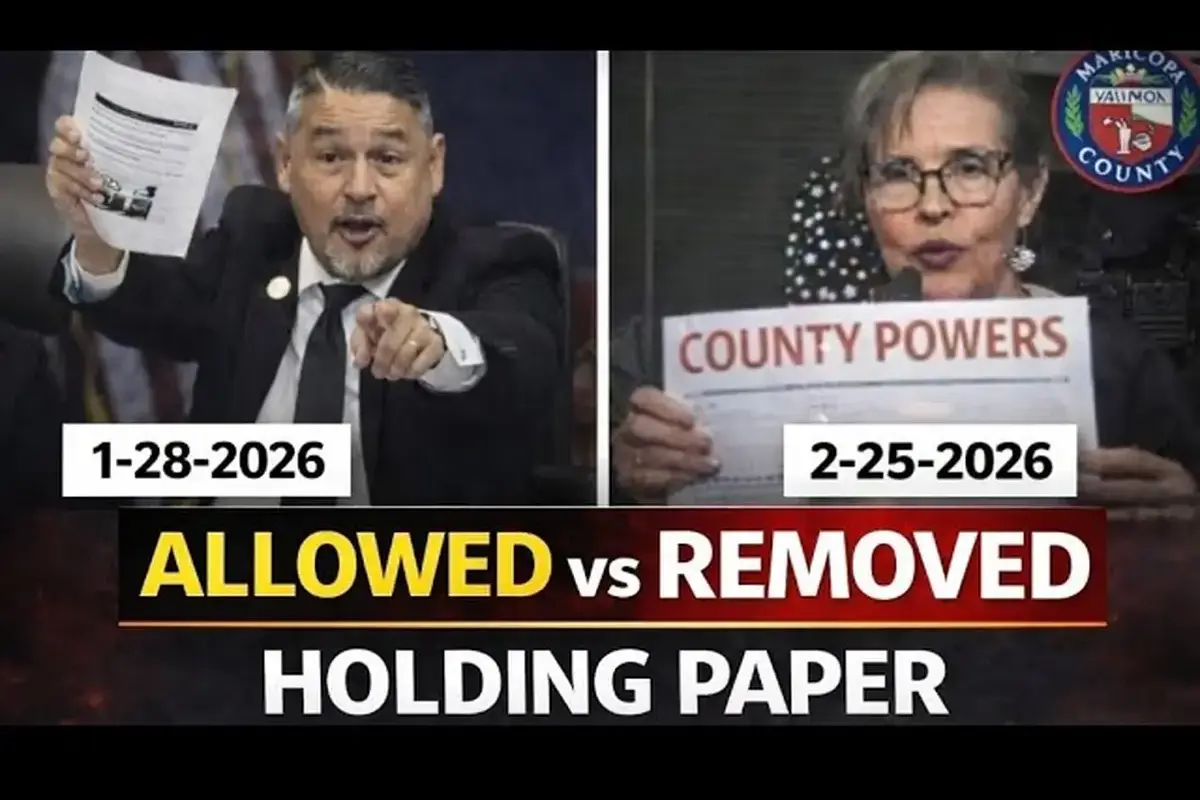
Maricopa County is currently experiencing an unprecedented breakdown in election administration governance, with the Board of Supervisors (BOS) and County Recorder Justin Heap locked in a multi-level legal conflict that has created an operational vacuum less than 60 days before early voting begins for the August 2026 primary election.
Key Findings at a Glance
| Issue | Status | Risk Level |
|---|---|---|
| Legal Authority | Split: Heap has statutory title; BOS has physical control via appellate stay | 🔴 Critical |
| Criminal Investigation | Active special prosecutor probe of Heap’s staff (concluding) | 🔴 Critical |
| SSA/Agreement | NONE — No valid Shared Services Agreement since January 2025 | 🔴 Critical |
| Election Infrastructure | BOS exclusively controls equipment, IT, databases | 🟡 Elevated |
| Timeline Pressure | ~60 days to early voting; logic testing/training at risk | 🔴 Critical |
The Core Conflict
What Happened
The dispute traces back to January 2025, when newly-elected Recorder Justin Heap terminated the existing Shared Services Agreement (SSA) that had governed coordination between the Recorder’s Office and the Board of Supervisors on election operations. This created an immediate operational vacuum.
In April 2025, the Board proposed a new SSA. Heap never responded. This left Maricopa County election administration operating without any formal intergovernmental agreement — a situation that persists as of June 2026.
The Flashpoint: March 2026 Scanner Incident
On March 26, 2026, multiple employees from Heap’s office attempted to “retrieve” a scanner from the county election center. According to Heap, they intended to repurpose it to scan provisional ballot envelopes — a function central to early ballot processing.
The Board treated this as unauthorized access to county equipment. In April 2026, County Attorney Rachel Mitchell appointed Special Prosecutor Kent Volkmer (former Pinal County Attorney) to investigate potential criminal conduct.
An internal HR investigation has already concluded that “something improper happened” during the scanner retrieval attempt.
Current Legal Status (June 20, 2026)
Active Litigation Timeline
| Date | Development | Impact |
|---|---|---|
| Jan 2025 | Heap terminates prior SSA | Creates operational vacuum |
| Apr 24, 2025 | BOS proposes new SSA; Heap never responds | No agreement in place |
| Jun 12, 2025 | Heap files lawsuit against BOS | Civil litigation begins |
| Jan 30, 2026 | Superior Court puts summary judgment under advisement | Delayed resolution |
| Apr 17, 2026 | Superior Court rules for Heap, orders authority restored | Brief 7-week window of Heap authority |
| Jun 9, 2026 | Court of Appeals issues 2-1 stay | BOS control restored; Heap blocked |
| Jun 19, 2026 | Appeals court rules, staying lower court order | Status quo maintained through election |
Current Judicial Posture
- Arizona Court of Appeals (Division One): Issued 2-1 ruling on June 19, 2026, staying the Superior Court’s April 17 order
- Board of Supervisors: Retains exclusive operational control of election infrastructure
- Recorder Heap: Blocked from assuming duties; has announced intent to seek Arizona Supreme Court emergency review
The appellate panel’s 2-1 split suggests substantive disagreement among judges on the merits, with one justice dissenting (reasoning not publicly detailed).
The Criminal Investigation
Special Prosecutor Kent Volkmer
| Aspect | Detail |
|---|---|
| Appointed | April 2026 by County Attorney Rachel Mitchell |
| Investigating | March 2026 scanner retrieval incident |
| Scope | Whether “criminal behavior” occurred (beyond HR finding of “improper” conduct) |
| Status | “Wrapping up” as of June 9, 2026 |
| Tactics | Off-duty Pinal County Sheriff’s deputy conducted field interviews |
Heap’s Response
On June 9, 2026, Heap filed an emergency motion in Superior Court seeking to halt the criminal investigation, alleging prosecutorial overreach. The motion specifically cited an incident where Volkmer’s investigator (an off-duty deputy) appeared at the home of Recorder’s Office employee “Colby” to question him about the scanner incident.
Volkmer defended the tactic as standard investigative practice: “I would say you’re not doing your job if you don’t try.”
No judicial stay has been issued on the criminal investigation as of June 20, 2026.
Operational Control: Who Controls What
| System/Function | Current Controller | Recorder Access |
|---|---|---|
| Tabulation Equipment/Scanners | Board of Supervisors (exclusive) | Denied — March attempt treated as unauthorized |
| Election IT Infrastructure | Board of Supervisors | No VPN, credentials, or admin rights |
| Voter Registration Databases | Board of Supervisors | Cannot query or update records |
| Signature Verification | Board of Supervisors | No equipment access for provisional ballots |
| Election Center Physical Access | Board-controlled | Recorder’s staff restricted |
| Data Center/Server Access | Board-appointed IT only | No entry privileges |
The Problem
Heap retains statutory authority as County Recorder under Arizona law, but the Board retains physical and operational control of all infrastructure needed to execute those duties. This is a recipe for operational paralysis.
Implications for the 2026 Election Cycle
Critical Timeline Constraints
With approximately 60 days until early voting begins for the August 2026 primary:
| Preparation Phase | Standard Timeline | Current Risk |
|---|---|---|
| Ballot Printing | Must begin by early July | Delayed due to authority uncertainty; vendor contracts frozen |
| Logic & Accuracy Testing | 4-6 weeks before early voting | Testing schedule frozen pending Supreme Court petition |
| Poll Worker Training | 3-4 weeks before early voting | Staff availability compromised by criminal investigation |
| Military/Overseas Ballots | ~45 days prior (~July 15) | Deadline at risk |
Chain of Custody Risks
The March 2026 scanner incident has created documented evidence of a chain-of-custody breach during an authority transition. This creates vulnerabilities for:
- Election certification challenges
- Equipment tampering allegations
- Provisional ballot integrity questions
The fact that an HR investigation already found “something improper happened” provides a paper trail that could be cited in post-election litigation.
Staffing Risks
Volkmer’s investigation has included home visits to election workers by an off-duty sheriff’s deputy. This creates:
- Chilling effect on election administration
- Potential witness intimidation claims
- Risk of key personnel unavailability during critical training period
Key Players and Their Positions
Maricopa County Board of Supervisors
Position: Asserts exclusive operational authority over election infrastructure; treats Recorder’s role as administrative/ministerial rather than operational.
Legal Strategy:
- Maintained physical control through appellate intervention
- Framed Heap’s equipment access attempts as criminal matters
- Used special prosecutor appointment to reinforce civil position
- Interprets SSA vacuum as defaulting authority to Board
Recorder Justin Heap
Position: Asserts constitutional/statutory independence; claims BOS obstruction violates election law.
Legal Strategy:
- Filed original lawsuit seeking declaratory relief
- Attempted unilateral equipment access (triggering criminal probe)
- Seeking Arizona Supreme Court emergency intervention
- Framing prosecutor tactics as harassment requiring judicial protection
County Attorney Rachel Mitchell
Role: Appointed Special Prosecutor Volkmer independent of civil litigation; maintains separation between criminal investigation and BOS v. Heap authority dispute.
Special Prosecutor Kent Volkmer
Role: Investigating potential criminal conduct regarding March scanner incident; operates independently from civil litigation but creates procedural tension through concurrent activity.
What’s Unknown / Critical Gaps
- Supreme Court Filing Status — Has Heap actually filed the emergency petition with the Arizona Supreme Court as announced?
- Investigation Conclusion — Volkmer says it’s “wrapping up” but has not disclosed timeline for charging decisions.
- Interim Coordination — Is there any ad hoc agreement governing day-to-day operations during the appellate period?
- Dissenting Justice’s Reasoning — The 2-1 appellate split suggests substantive disagreement; what was the dissent’s basis?
- Equipment Access Protocols — What specific security measures are in place to prevent additional unauthorized access attempts?
Citizen Recommendations
Immediate Transparency Demands
- Publish the April 24, 2025 proposed SSA — What exactly did the Board offer that Heap never answered?
- Disclose scanner incident details — What equipment, what employees, what time, what security footage exists?
- Clarify Volkmer’s mandate — What specific criminal statutes are under consideration?
- Document chain-of-custody protocols — What changed after March 2026 to prevent recurrence?
Public Records Requests to File
- All emails between County Attorney’s Office and Special Prosecutor Volkmer regarding scope of investigation
- HR investigation report into March scanner incident
- Security footage/logs from March 26, 2026 election center access
- Current SSA negotiations or interim coordination agreements
- Training schedules and staff assignments for August 2026 primary
Sources
This report is based on research compiled June 20, 2026, drawing from:
- Votebeat Arizona
- Arizona Mirror
- FOX 10 Phoenix
- KJZZ
- Tucson Sentinel
- Maricopa County official communications
- Arizona Court of Appeals proceedings
See full research file: BOS v Heap Election Dispute Research-06-20-2026.md
Conclusion
Maricopa County is operating its election administration through a judicially-maintained limbo that separates legal authority from operational capacity. The Board of Supervisors controls the machinery; the Recorder holds the statutory title; a special prosecutor investigates the staff; and the courts have created a temporary status quo that expires… when?
With early voting approaching and no Shared Services Agreement in place, this is not a sustainable governance model. The August 2026 primary will proceed under these conditions unless the Arizona Supreme Court intervenes — and even then, the practical constraints of equipment, training, and chain-of-custody may be insurmountable in the remaining timeline.
The risk is not just legal confusion. It’s operational failure.