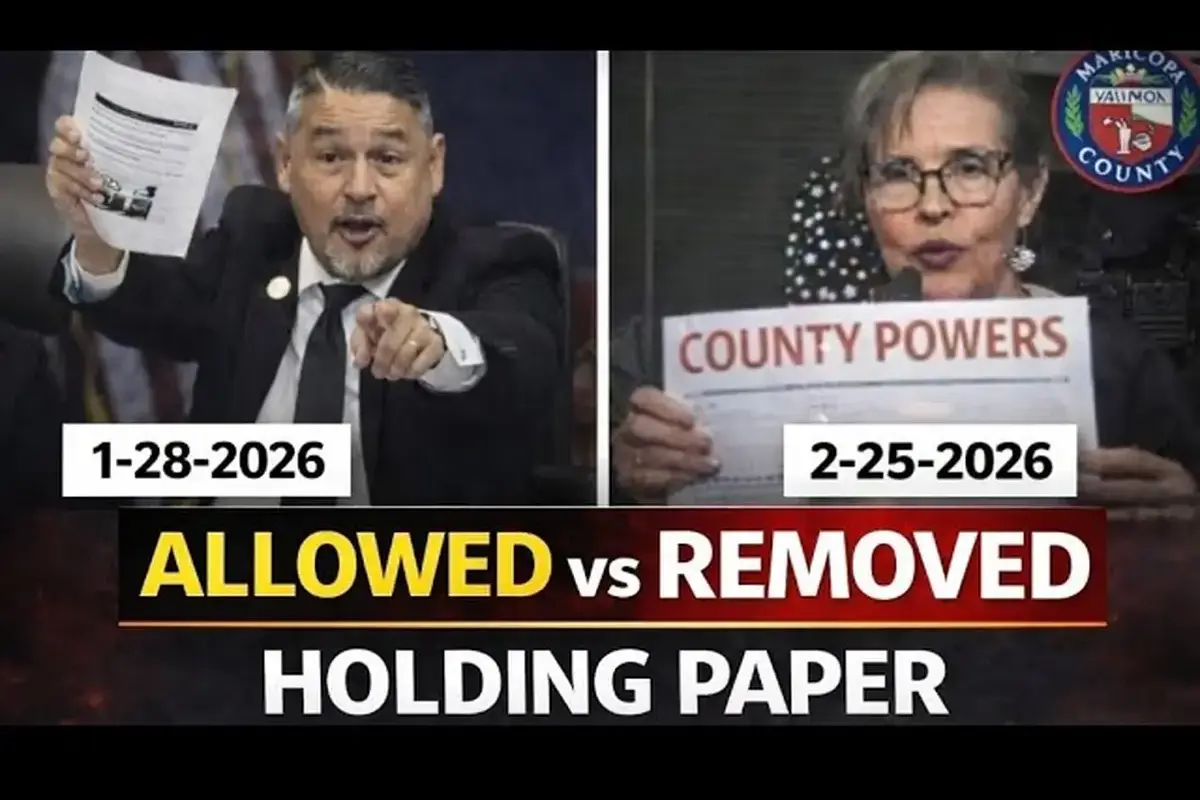
The Board convened for a 5-minute Special Meeting solely to enter Executive Session—discussing school finances, Treasurer technology, and tax authority in closed session with outside counsel.
Key Facts:
- 0 minutes of public business conducted
- 3 legal advice topics discussed in Executive Session
- 2 outside law firms present (Tully Bailey LLP, Taft Law)
- Steve Gallardo absent (4 of 5 supervisors present)
- Debbie Lesko made the sole motion
Bottom line: A procedural meeting that locked the public out of discussions on school district levies, Treasurer technology spending, and Board tax authority.
🏛️ THE MEETING: NOTHING PUBLIC
Attendance
| Supervisor | Status | Note |
|---|---|---|
| Kate Brophy McGee | ✅ Present | Chair |
| Debbie Lesko | ✅ Present | Vice Chair |
| Mark Stewart | ✅ Present | Remote |
| Thomas Galvin | ✅ Present | Remote |
| Steve Gallardo | ❌ Absent | — |
Staff Present: Juanita Garza (Clerk), Mia Vargas (Minutes), Jen Pokorski (County Manager), Brooke Worcester (Legal Counsel)
Meeting Duration: Minimal—convened, voted to enter Executive Session, adjourned to closed session.
🗳️ THE VOTE: UNANIMOUS BY THOSE PRESENT
Motion to Enter Executive Session
| Supervisor | Vote | Note |
|---|---|---|
| Lesko | ✅ Aye | Motion maker |
| Galvin | ✅ Aye | Seconded |
| Brophy McGee | ✅ Aye | — |
| Stewart | ✅ Aye | Remote |
| Gallardo | 🚫 Absent | — |
Result: PASSED 4-0 (1 absent)
🔒 EXECUTIVE SESSION: WHAT WAS DISCUSSED
The Board recessed into Executive Session under A.R.S. §38-431.03(A)(3) to discuss three legal advice matters:
Item 1: School District Cash Deficit Levies
Topic: Legal advice regarding school district cash deficit levies—potentially involving property tax calculations for school funding shortfalls.
Participants Present:
- Legal: Aubrey Joy Corcoran, Wesley Van Cleve (Deputy County Attorneys)
- School District: Shelli Boggs (School Superintendent), Dajana Zlaticanin (Chief Deputy), Jordan Fasano (Finance)
- County Finance: Mike McGee (CFO), Bridget Harper (Deputy Director), Vicki Hanson (Special Projects)
What this means: Maricopa County is the backstop when school districts face cash flow problems. This involves complex property tax levy calculations and potentially millions in taxpayer obligations.
Item 2: Treasurer’s Office Technology Update
Topic: Legal advice on technology systems in the County Treasurer’s office—likely involving procurement, vendor contracts, or system integration.
Participants Present:
- Outside Counsel: Steve Tully, Tully Bailey LLP
- Treasurer’s Office: Michael Hunter (Chief Deputy), Jordan Dale (Chief of Staff), Jeanine Jones (Legal/Legislative), James Moore (CTO)
- County Finance/IT: Mike McGee (CFO), Bridget Harper, Richard McHattie (CIO)
What this means: The Treasurer handles billions in property tax collections. Any technology update involves massive financial system risk and likely significant procurement dollars. Outside counsel suggests potential legal complexity or disputes.
Item 3: Tax Levy and Tax Rates; Board Authority
Topic: Legal advice on Board authority regarding tax levies and rates—potentially involving limits, calculations, or challenges to Board discretion.
Participants Present:
- Outside Counsel: Emily Craiger, Taft Law
- County Finance/IT: Mike McGee (CFO), Bridget Harper, Richard McHattie (CIO)
What this means: This touches the Board’s core fiscal power. Tax rates affect every property owner in Maricopa County. Outside counsel involvement suggests either contested authority or significant rate-setting decisions pending.
🚨 RED FLAGS FOR CITIZEN WATCHERS
1. Triple Outside Counsel
Two different outside law firms (Tully Bailey, Taft Law) plus County Attorney staff for three separate topics. This suggests:
- Specialized expertise needed (tax law, procurement law)
- Potential litigation exposure (why else pay outside rates?)
- Internal conflict avoidance (using outside counsel when County Attorney has potential conflict)
2. CFO Present for All Three Items
Mike McGee attended every Executive Session discussion. When the CFO is in closed session for tax authority, school levies, AND technology procurement, money is on the table—potentially lots of it.
3. Absence Pattern
Steve Gallardo was absent. July 23, 2026 timing suggests possible DNC-related travel (Democratic convention activities). His absence on a day discussing tax authority and school levies—core Democratic constituency issues—is notable.
4. No Public Output
Unlike some Executive Sessions that result in public votes or announcements, this meeting produced zero public record of decisions or action items. Citizens have no visibility into what was decided or what comes next.
5. The Lesko Motion Monopoly
Debbie Lesko made the sole substantive motion. Pattern continues from previous meetings where one supervisor controls the procedural agenda.
💰 WHAT COULD BE AT STAKE
Based on the participants and topics:
| Topic | Potential Financial Impact | Why It Matters |
|---|---|---|
| School District Levies | $10M-$100M+ | Property tax supplements for cash-strapped districts |
| Treasurer Technology | $1M-$10M+ | Core financial system procurement/upgrade |
| Tax Authority/Limits | $100M+ annually | Board discretion on property tax rates affects every homeowner |
Total potential exposure: Hundreds of millions in taxpayer obligations, procurement contracts, or rate-setting authority.
All discussed behind closed doors.
📋 COMPARISON: JULY 14 vs JULY 23
| Aspect | July 14 Emergency | July 23 Special |
|---|---|---|
| Public Business | $32.4M settlement, split elections | None |
| Public Input | Excluded (emergency) | Excluded (Executive Session) |
| Vote Split | 3-1 (Gallardo NO) | 4-0 (Gallardo absent) |
| Motion Maker | Debbie Lesko | Debbie Lesko |
| Duration | ~90 minutes | ~5 minutes public |
| Transparency | Minimal | Zero |
Pattern: Whether public business happens or not, Debbie Lesko controls the motions and citizens are kept outside the room.
🎯 WHAT HAPPENS NEXT
Watch For:
- School District Agenda Items — Any public votes on cash deficit levies
- Treasurer Technology Contracts — Procurement announcements or IT system changes
- Tax Rate Authority Resolutions — Board votes clarifying or asserting tax-setting power
- Executive Session Follow-ups — Items that “emerged” from closed session discussion
Timeline Clues:
- Tax rates are typically set in August-September for following fiscal year
- School district levies align with academic year (July-June)
- Technology procurements often have 30-90 day decision windows
📊 THE POWER DYNAMIC
Who Was in the Room (Executive Session):
- 2 Outside Law Firms (Tully Bailey, Taft)
- County Attorney’s Office (Corcoran, Van Cleve)
- County Finance (McGee, Harper)
- School District Administration (Boggs, Zlaticanin, Fasano)
- Treasurer’s Leadership (Hunter, Dale, Jones, Moore)
- IT Leadership (McHattie)
Who Was NOT in the Room:
- Elected Treasurer (not listed as present)
- Any Board member besides the 4 voting
- Any member of the public
- Any press
This is who decides how your property taxes get calculated and collected.
💡 CITIZEN TAKEAWAY
This meeting represents perfect procedural opacity:
✅ No public business conducted
✅ No public input allowed
✅ No transparency on decisions
✅ No follow-up disclosed
✅ Hundreds of millions in potential taxpayer impact
The Board followed the letter of open meeting law (published agenda, statutory citation for Executive Session) while achieving total substantive concealment.
The questions you’ll never get answers to:
- Which school districts face cash deficits?
- What technology is the Treasurer buying?
- Will tax rates change next year?
- Why did they need outside counsel?
- What did they decide?
What you can do:
- File public records requests for any documents generated from these discussions
- Monitor August-September agendas for related action items
- Watch for procurement announcements from Treasurer’s Office
- Track school district levy votes when they appear
This is how hundreds of millions in public obligations get decided: not with votes you can see, but with conversations you’ll never hear.
This is a citizen analysis based on public records.
Sources: Official agenda, meeting summary, Executive Session agenda