
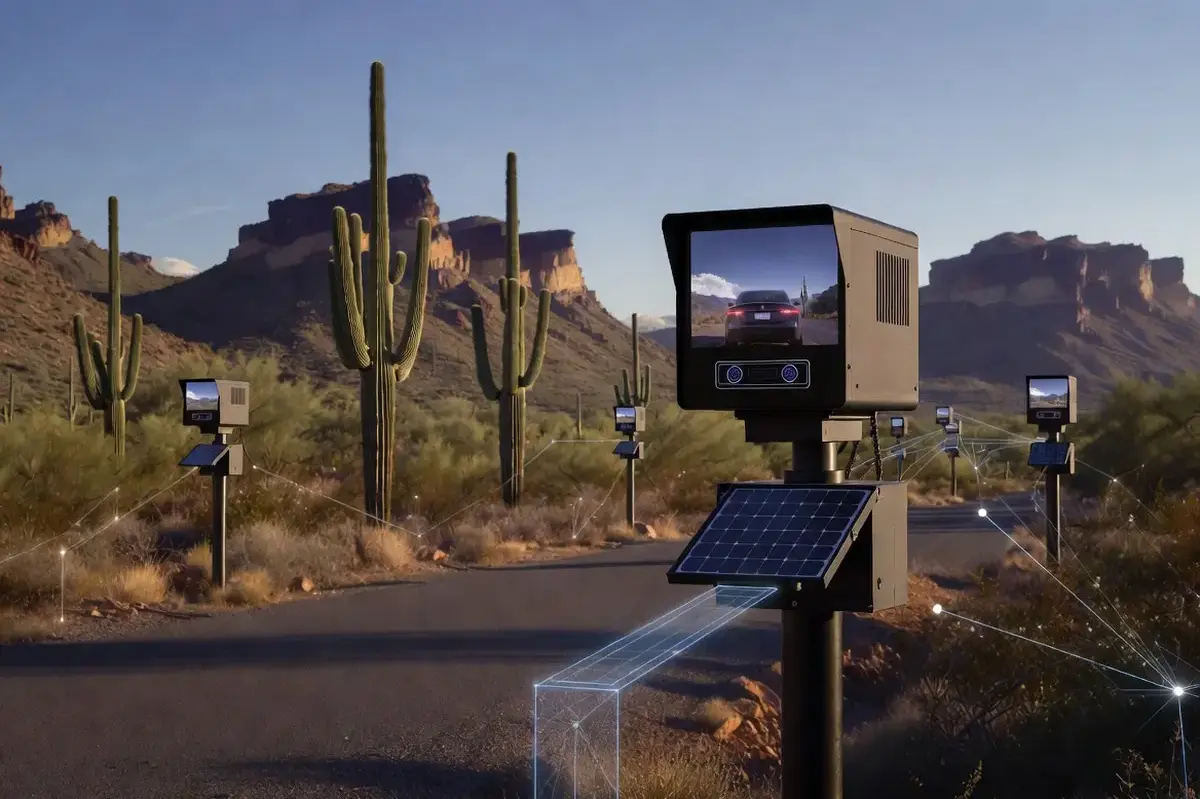
Automated License Plate Reader Deployment, Data Practices, and Accountability Gaps
Maricopa County, Arizona operates one of the most extensive automated license plate reader (ALPR) networks in the United States, anchored by a $45 million county-wide contract with Flock Safety through June 2027. This system captures millions of vehicle scans monthly, automatically shares data with ICE and Border Patrol, and lacks comprehensive statutory oversight.
Key Findings:
- Scottsdale Police alone conducted 12,527 database searches — roughly 22% of all Arizona agency searches in available data
- No Arizona statute governs ALPR data retention, warrant requirements, or sharing with federal immigration authorities
- Fragmented vendor landscape: MCSO uses Flock; Mesa PD uses Vigilant Solutions — creating interoperability and accountability gaps
- Active citizen opposition through unFlock Scottsdale, DeFlock mapping project, and Maricopa County Libertarian Party
- Status of Phoenix, Tempe, Chandler, Glendale, Peoria, and Surprise remains unverified — transparency gaps in major municipalities
1. Deployment Infrastructure
1.1 Maricopa County Sheriff’s Office (MCSO) — County-Wide Network
MCSO operates the largest ALPR network in Arizona through a $45 million contract extension with Flock Safety effective through June 30, 2027. This agreement consolidifies automatic license plate readers, AeroDome drones, operating systems, and data networks under unified Sheriff’s Office control.
Contract Details:
- Value: $45 million (multi-year extension)
- Duration: Through June 30, 2027
- Scope: ALPR hardware, drone integration, networked data systems
- Model: Centralized county procurement replacing fragmented municipal contracts
Source: CiviciQ Public Safety Tech Update, 2026 — blogs.civiciq.com/2026/01/11/2026-public-safety-tech-update-axons-45m-dominance-drone-first-responders-ai-report-writing
Strategic Justification:
Sheriff Ross Teeple has publicly defended the county-wide expansion, emphasizing specific investigative outcomes:
“Those cameras enhance public safety. All the Flock cameras do is just record traffic that goes by, and I can’t tell you how many Silver Alerts have been resolved and Amber Alerts that have been resolved from those cameras.”
— Sheriff Ross Teeple, May 2025 community meeting
Source: InMaricopa — inmaricopa.com/rock-out-with-your-flock-out
1.2 Municipal Deployment Patterns
| Municipality | Vendor | Procurement Model | Status |
|---|---|---|---|
| Scottsdale PD | Flock Safety | Independent municipal | ✅ Active |
| Mesa PD | Vigilant Solutions (Motorola) | Independent municipal | ✅ Active |
| City of Maricopa | Flock Safety | Independent municipal | ✅ Active |
| Youngtown | Flock Safety (via MCSO) | Sheriff’s Office contract | ✅ Active |
| Phoenix PD | Unknown | — | ⚠️ Unverified |
| Tempe PD | Flock (confirmed use) | — | ⚠️ Partially verified |
| Chandler PD | Unknown | — | ⚠️ Unverified |
| Glendale PD | Unknown | — | ⚠️ Unverified |
| Peoria PD | Unknown | — | ⚠️ Unverified |
| Surprise PD | Unknown | — | ⚠️ Unverified |
Scottsdale PD — Flock Hotspot:
Scottsdale Police Department conducted 12,527 searches of the Flock database, representing approximately 22% of the total searches conducted by Arizona agencies in available data.
Source: AZ Mirror, January 2026 — azmirror.com/2026/01/20/scottsdale-pds-massive-use-of-ai-license-plate-tracking-cameras-raises-privacy-concerns
Mesa PD — Separate Vendor Network:
Mesa Police Department operates Vigilant Solutions automated license plate readers (Motorola subsidiary), sharing data with nearly 800 agencies across the country. This creates a parallel surveillance network with different data governance protocols than Flock.
Source: Atlas of Surveillance — atlasofsurveillance.org/a/aos000282-mesa-police-department-automated-license-plate-readers
Youngtown — Contracted Municipal Model:
Youngtown contracts with Flock Safety specifically structured to enhance “Law Enforcement as provided by the Maricopa County Sheriff’s Office (MCSO),” with camera infrastructure feeding directly into MCSO’s centralized Flock system.
Source: Town of Youngtown — youngtownaz.org/community/flock_safety_cameras.php
1.3 Geographic Distribution
Confirmed Deployments:
- Unincorporated Maricopa County: Covered by MCSO $45M contract
- Scottsdale: Residential neighborhoods, commercial corridors, major intersections
- Mesa: Patrol cars and fixed locations (Vigilant system)
- City of Maricopa: Independent municipal deployment
- Youngtown: MCSO-contracted coverage
Spatial Patterns:
Camera density concentrates at residential neighborhood ingress points, commercial corridors within incorporated cities, and major arterial roadways in unincorporated areas.
2. Data Practices and Federal Sharing
2.1 Retention Policies
Arizona state law imposes no statutory data retention limits for ALPR systems. Retention periods are determined solely by vendor contracts and local agency policy.
| Jurisdiction | Retention Policy | Governing Authority |
|---|---|---|
| MCSO/Flock | Through June 2027 (contract term) | Service agreement |
| Mesa/Vigilant | Grant conditions and local policy | Municipal discretion |
| Statewide | No statutory maximum | Contract-based governance |
Source: CityRuleLookup — cityrulelookup.com/privacy-surveillance/license-plate-readers/maricopa-county-az
2.2 Federal Data Sharing
ICE and Border Patrol Access:
Plate captures from Arizona Flock systems are automatically entered as “searchable data points” available to:
- Police agencies
- ICE (Immigration and Customs Enforcement)
- Border Patrol
- Other agencies with Flock contracts
This unrestricted sharing environment exists because no Arizona statute limits law enforcement data transfers to immigration authorities.
Source: DeFlock Tucson — deflocktucson.com
2.3 Documented Misuse and Controversies
Protest Monitoring — Tempe:
Tempe officers have used Flock searches to monitor protestors, demonstrating mission creep beyond traditional law enforcement purposes.
Source: Factually — factually.co/fact-checks/justice/arizona-law-enforcement-license-plate-scanning-3f099a
Additional Documented Concerns:
- Agencies have fielded queries tied to immigration enforcement
- National reporting raised alarms about cross-jurisdictional searches in sensitive cases (e.g., tracking people seeking abortions)
- Vehicle characteristics (make, model, color, bumper stickers) automatically entered as searchable data points
3. Citizen Opposition and Advocacy
3.1 Organized Opposition Groups
| Organization | Focus | Key Actions |
|---|---|---|
| unFlock Scottsdale | Scottsdale-specific opposition | Dedicated website: unflockscottsdale.com; community organizing |
| DeFlock | National ALPR mapping | maps.deflock.org; Tucson chapter active |
| Maricopa County Libertarian Party | County-wide advocacy | Eric Fowler testimony at Board of Supervisors; warrant requirement advocacy |
| Secure Justice | Criminal justice reform | Formal complaint to MCSO early 2025; forced Board testimony |
Eric Fowler Testimony:
Eric Fowler, chairman of the Maricopa County Libertarian Party, has testified regarding ALPR proliferation:
“I don’t see a great way of corralling that use without extremes, amounts of guardrails and warrants.”
Source: ABC15 — abc15.com/news/local-news/investigations/your-car-is-being-tracked-heres-who-can-access-that-data-in-arizona
Secure Justice Intervention:
Secure Justice successfully urged formal questioning of Flock Safety representatives at Maricopa County Board of Supervisors meetings in early 2025, forcing vendor accountability in a public forum.
3.2 Board of Supervisors Political Dynamics
The Maricopa County Board of Supervisors maintains divided positions on Flock Safety ALPR expansion.
July 2025 Vote:
- Approved: Retroactive $303,600 contract extension covering July 2025–June 2026
- Vote: 3-2 split
- Opposition: Dissenting supervisors characterized the program as “mass surveillance”
Note: Specific supervisors voting for/against this contract are not documented in publicly available sources. Meeting minutes from Maricopa County Clerk of the Board would be required to identify individual votes.
Source: Silicon Valley News — siliconvalley.com/2026/04/22/alameda-county-supervisors-ok-contract-with-flock
4. Regulatory Environment
4.1 Arizona State Law — Statutory Void
Arizona currently has no comprehensive statutory framework governing ALPR deployment, data retention, or access restrictions.
| Regulatory Element | Arizona Status | Impact |
|---|---|---|
| ALPR-specific statutes | None | Contract-based governance only |
| Data retention limits | No statutory maximum | Vendor determines retention |
| Warrant requirements | None | Policy-based discretion only |
| Federal data sharing restrictions | None | Automatic ICE/Border Patrol access |
| Judicial authorization for queries | No mandate | “Supplement to investigations” standard |
Source: DeFlock Tucson — deflocktucson.com; ABC15 — abc15.com/news/local-news/investigations/your-car-is-being-tracked-heres-who-can-access-that-data-in-arizona
4.2 Legislative Trends
Senate Bill (2026):
Arizona Senate panel advanced legislation that would shield police surveillance cameras from public scrutiny, restricting public records access to ALPR data.
Proposed Restrictions:
- ALPR data could only be viewed by law enforcement or via subpoena
- Public records requests — instrumental in understanding police ALPR use — would be eliminated
Source: AZ Mirror, February 2026 — azmirror.com/2026/02/10/senate-panel-advances-bill-that-shields-police-surveillance-cameras-from-public-scrutiny
5. Private Sector Integration
5.1 Public-Private Surveillance Networks
Homeowner associations (HOAs), shopping centers, and private entities operate Flock Safety subscriptions that feed directly into law enforcement databases.
Documented Pattern:
- HOAs monitor neighborhood entrances
- Shopping centers track parking lots
- Private camera data automatically shared with police, ICE, Border Patrol
Accountability Gap:
Private entities operate surveillance without public oversight, subject only to Flock Safety contractual terms rather than government transparency requirements.
Source: CityRuleLookup — cityrulelookup.com/privacy-surveillance/license-plate-readers/maricopa-county-az
Note: Specific HOAs, shopping centers, or private entities operating Flock cameras in Maricopa County are not publicly identified in available sources.
6. Contractual and Financial Details
6.1 Procurement Irregularities
The July 2025 Board of Supervisors approval of a $303,600 retroactive contract extension — covering services already rendered without prior authorization — raises governance concerns.
Contract Specifics:
- Amount: $303,600
- Period: July 2025–June 2026
- Nature: Mostly retroactive (paying for services already provided)
- Approval: 3-2 Board vote
National Context:
Flock Safety faced “well-publicized accusations” contributing to 82 contract terminations across 28 states between August 2021 and May 2026.
Source: GovTech — govtech.com/spotlight/why-flock-safety-finds-itself-in-a-surveillance-backlash
6.2 Vendor Influence
Flock Safety maintains extensive lobbying relationships with law enforcement leadership nationwide. The $45 million MCSO contract through June 2027 embeds Flock systems deeply into county infrastructure, creating vendor dependency.
7. Transparency Gaps and Verification Needs
7.1 Unverified Jurisdictions
The following major Maricopa County municipalities have unconfirmed ALPR status:
- Phoenix (state capital, 1.6M population)
- Tempe (confirmed Flock use for protest monitoring; full scope unknown)
- Chandler
- Glendale
- Peoria (Atlas of Surveillance confirms drones, not ALPRs)
- Surprise
Transparency Failure:
Lack of public documentation for ALPR deployment in major cities prevents comprehensive accountability.
7.2 Data for Public Records Requests
MCSO/Flock Safety:
- Flock Safety audits and network sharing agreements
- Query logs (who searched what, when, why)
- Data retention and deletion schedules
- ICE/Border Patrol access logs
Individual Municipalities:
- Vendor contracts for Phoenix, Tempe, Chandler, Glendale, Peoria, Surprise
- Camera location maps
- Usage policies and audit results
Board of Supervisors:
- July 2025 meeting minutes with individual supervisor votes
- Public testimony transcripts
- Contract justification documents
8. Key Findings Summary
What is Confirmed
- MCSO operates a $45 million county-wide Flock network through June 2027
- Scottsdale PD is a Flock hotspot — 22% of Arizona’s searches from one city
- Mesa PD runs a separate Vigilant network — fragmentation creates accountability gaps
- No Arizona statute governs ALPR data, retention, or federal sharing
- ICE and Border Patrol have automatic access to Arizona Flock data
- Tempe officers used Flock to monitor protestors
- Citizen opposition is active through unFlock Scottsdale, DeFlock, and Libertarian Party
- July 2025 retroactive contract approved 3-2; individual votes unknown
What Remains Unknown
- Board of Supervisors vote breakdown (which supervisors approved/dissented)
- Phoenix, Tempe, Chandler, Glendale, Peoria, Surprise ALPR status
- Specific HOA and private entity camera locations
- Actual query volumes and search justifications
- Audit results showing compliance or misuse
9. For Citizens: Action Items
Immediate Steps
- Request Board of Supervisors meeting minutes (July 2025 Flock contract vote) to identify which supervisors supported “mass surveillance”
- Contact your city council to demand ALPR vendor disclosure for Phoenix, Tempe, Chandler, Glendale, Peoria, Surprise
- Submit public records requests for Flock query logs in your municipality
Ongoing Monitoring
- Track Senate Bill progress on shielding surveillance cameras from public scrutiny
- Monitor unFlock Scottsdale and DeFlock for organizing opportunities
- Watch for special prosecutor or audit findings on ALPR misuse
Questions to Ask Officials
- Does your police department use Flock Safety, Vigilant, or other ALPR vendors?
- How many searches were conducted in the past year?
- What is your data retention policy?
- Is data automatically shared with ICE or Border Patrol?
- Are there private entities (HOAs, businesses) feeding data into your system?
Sources
Document Notes
Research Date: July 10, 2026
Classification: Citizen accountability documentation
Limitations: This report reflects publicly available information as of July 10, 2026. Specific camera locations, complete municipal deployment lists, and individual supervisor votes require additional public records requests. Private entity (HOA/business) camera locations are not comprehensively mapped.