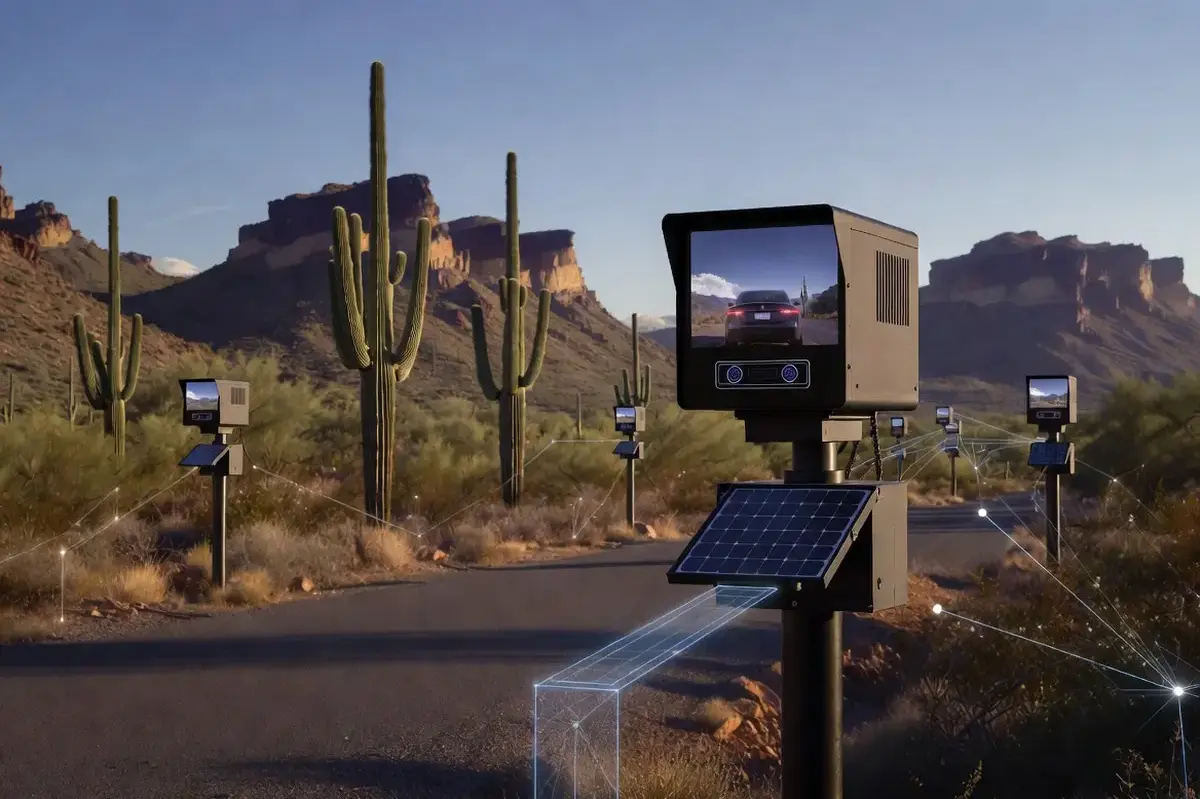

License plate readers are only one piece of a much larger picture. Technology changes. The oath does not.
They call it a license plate reader. That is the sales pitch. The systems now being installed across American cities — including communities in and around Maricopa County — do far more than snap a plate as a car rolls through an intersection.
A short preview video circulating under the title Flock Facts: Surveillance 101 & More! makes that point without wasting time. License plate readers are one product in a rapidly expanding industry. The companies change. The contracts change. The cameras get quieter, smarter, and harder to see. The oath of office does not change with them.
This is not a left issue or a right issue. It is a freedom issue. Pinal County has already drawn a line. Citizens in Chandler have already stood at the microphone. The Maricopa County Board of Supervisors will keep meeting. The questions will keep arriving. The people who took an oath should be ready to answer them.
What the Sample Video Is Actually About
The preview is not a campaign ad against one brand name. It is a warning against vendor substitution. Cities cancel a Flock Safety contract after public outcry, then turn around and sign with another firm that sells cameras, body-worn video, Tasers, and AI “crime centers.” The logo on the pole changes. The dragnet does not.
Denver is the cleanest public example. After months of protest over Flock’s data-sharing practices, the city let that contract expire in March 2026. It did not shut the cameras off. Denver City Council approved a one-year Axon contract for fifty automated license plate readers. Douglas County, next door, approved a much larger Axon package that includes Outpost cameras and a countywide drone network.
That is the pattern the video is asking viewers to notice. Taking a Flock camera off a pole is not the same thing as ending warrantless, continuous location tracking of ordinary people.
Watch the Video!
The Industry Behind the Pole
Flock Safety built a national network of automated license plate readers used by thousands of agencies. Axon Enterprise — headquartered in Scottsdale, inside Maricopa County — already supplies Tasers, body cameras, in-car video, evidence software, and now competing ALPR hardware marketed as Axon Outpost. Axon has also partnered with Ubicquia to put cameras into existing streetlights so a city does not even have to plant a new pole.
Outpost is sold as two cameras in one: a plate reader and a live-stream camera with a wider field of view. Company materials describe edge-based “vehicle signature” analysis — make, model, color, visible damage, roof racks, bumper stickers. The pitch is public safety. The architecture is persistent recording of public movement.
Large index-fund managers hold major stakes in Axon, as they do in most large public companies. BlackRock, Vanguard, and State Street are among the biggest institutional holders. That fact does not, by itself, prove a conspiracy. It does prove that the surveillance business is now a mainstream financial product. When cameras become a growth industry, the pressure is to install more of them, not fewer.
Flock’s own tools have already moved past plates. Reporting in 2026 documented police use of Flock’s FreeForm search to look for people — “person wearing scrubs,” a man in a black t-shirt, a woman in Ugg boots — across networks of cameras. Flock says the feature does not use facial recognition and that some identity-based searches are blocked. The capability still answers a different question than “what plate just passed this intersection?” It asks, “who walked by, and what were they wearing?”
The Questions Every Official Should Answer
The video, and every serious citizen comment on this subject, comes back to the same list. These are not rhetorical flourishes. They are the minimum a Board of Supervisors, a city council, or a sheriff should be able to answer in public, on the record, before another dollar is spent.
- Who collects the data — the agency, or a private vendor with its own cloud?
- Who may search it — local officers only, out-of-state police, federal agencies, or the vendor’s staff?
- How long is it kept, and does the vendor keep a copy after the city “deletes” it?
- Is there a national or multi-state network that turns one city’s camera into another state’s lead?
- What audit trail exists, and can the public see it?
- Where does a warrant fit — or is the whole traveling public treated as a suspect pool?
If an official cannot answer those questions, the contract is not ready. If the vendor answers them and the elected body cannot repeat the answers without reading a brochure, the oversight is not real.
What the Constitution Already Says
The Fourth Amendment was written by people who had lived under general warrants. British writs of assistance let the Crown’s officers search any house, any person, with no particular suspicion and no judge looking over their shoulder. James Otis argued against that power in Boston in 1761. The Framers answered with one word that still binds every supervisor and every sheriff: particularly.
No warrant shall issue without particularly describing the place to be searched and the persons or things to be seized. A camera network that records every car, and increasingly every passerby, so that the government can search the pile later is the digital version of the general warrant.
Arizona goes further. Article 2, Section 8 of the Arizona Constitution states: “No person shall be disturbed in his private affairs, or his home invaded, without authority of law.” That is not a slogan. It is a command to every officer who raised a hand and swore an oath in this state.
The United States Supreme Court has already drawn related lines. In Carpenter v. United States (2018), the Court held that the government needs a warrant to obtain historical cell-site location records held by a private company, because people have a reasonable expectation of privacy in the whole of their physical movements. In Chatrie v. United States (June 29, 2026), the Court held 6–3 that police conduct a Fourth Amendment search when they obtain a person’s location history from Google through a geofence demand — even when the window is short and the data sits with a third-party company.
ALPR vendors will say a plate on a public road is not a cell phone in a pocket. That distinction is real in older case law about isolated plate scans. It gets weaker every year the systems add video, vehicle “signatures,” pedestrian search, multi-state sharing, and months of searchable history. Pinal County Sheriff Ross Tele made that exact point when he ordered his office off Flock: basic plate readers on a public road are one thing; AI pattern-tracking of daily life is another.
Congress Has Not Banned the Cameras — and That Matters
The sample video mentions Rep. Tim Burchett of Tennessee and a bill to “ban these things nationwide.” The actual bill is narrower, and citizens should know the difference so they are not arguing a law that does not exist.
H.R. 9800, the Protection Against Mass Surveillance Act, introduced July 21, 2026, would bar federal agencies from buying, operating, or accessing automated surveillance systems that identify or track people — including Flock-style ALPRs, facial recognition, and other biometric tools. It would also block state and local governments from using federal funds for those systems. It does not, by itself, rip cameras off Maricopa County poles. Local contracts paid with local dollars would still be a local fight.
That is why the oath still matters here. Washington may squeeze the federal money. It will not do the Board’s job. Supervisors, sheriffs, and city councils decide whether Maricopa County treats every driver as a data point.
Maricopa County Is Not a Spectator
Chandler residents have already told their council the same thing this video tells the country: the data is stored somewhere, for some period, searchable by someone, and the public was asked to pay for the privilege of being logged. Speakers have cited Carpenter, Kyllo, Katz, and Chatrie. They have noted that you can leave a phone at home. You cannot opt out of a camera bolted over a public road.
Pinal County showed what an oath looks like when it is taken seriously. Sheriff Tele canceled the Flock contract under his control, and his supervisors stood behind him. He said he would protect individual liberties until the day he dies. That is the standard. It is not partisan. It is the job.
Axon’s headquarters sit in Scottsdale. That does not make the company a villain and it does not make the product harmless. It means the debate is not happening somewhere else. The industry lives here. The Board meets here. The people who drive these roads live here.
The Tired Arguments
“If you have nothing to hide, you have nothing to fear.” That line has been used to excuse every general warrant in history. The Fourth Amendment does not protect only the guilty. It protects the innocent from becoming a file.
“You already carry a phone.” Yes. And Carpenter says the government still needs a warrant to vacuum that trail from the company that holds it. The existence of one tracking tool is not a license to build another with no particularized suspicion and no off switch.
“It solves crime.” Some investigations have used plate hits. Public safety is a real duty. So is the Constitution. Ben Franklin’s warning is quoted often because it keeps being necessary: those who give up essential liberty to purchase temporary safety deserve neither. If you are monitored as a condition of driving to work, you do not have the liberty the Founders described. You have a permission slip.
“Where the Spirit of the Lord is, there is liberty.”
— 2 Corinthians 3:17
Liberty in Scripture is not lawlessness. It is life under just authority, not under a machine that never sleeps. Officials who remember that — and citizens who insist on it — are doing their duty.
Draw the Line Before the Next Contract
Watch the sample. Then watch the full presentation when it is released. Then go to the next Board or council meeting with the six questions in hand. Do not accept a brand change as a reform. Do not accept “public safety” as a substitute for a retention policy, an access log, and a warrant standard.
It Is Our Duty has already published a citizen notice on Flock Safety and ALPR systems in Maricopa County, and the anthem post “Get the Flock Outta Here: Drawing the Line on Surveillance.” This commentary sits beside those pieces. The notice places officials on the record. The song names the line. This post names the industry that will keep walking up to that line under a new logo.
Ask who controls the cameras in your community. Demand answers on access, retention, sharing, and search. Support officials who stand with the Constitution rather than with the next vendor. Share the video. Bring the questions. Keep the oath in view.
Technology changes. The oath does not.
Fourth Amendment — draw the line. Your rights are yours, and mine are mine. We the people still have rights.