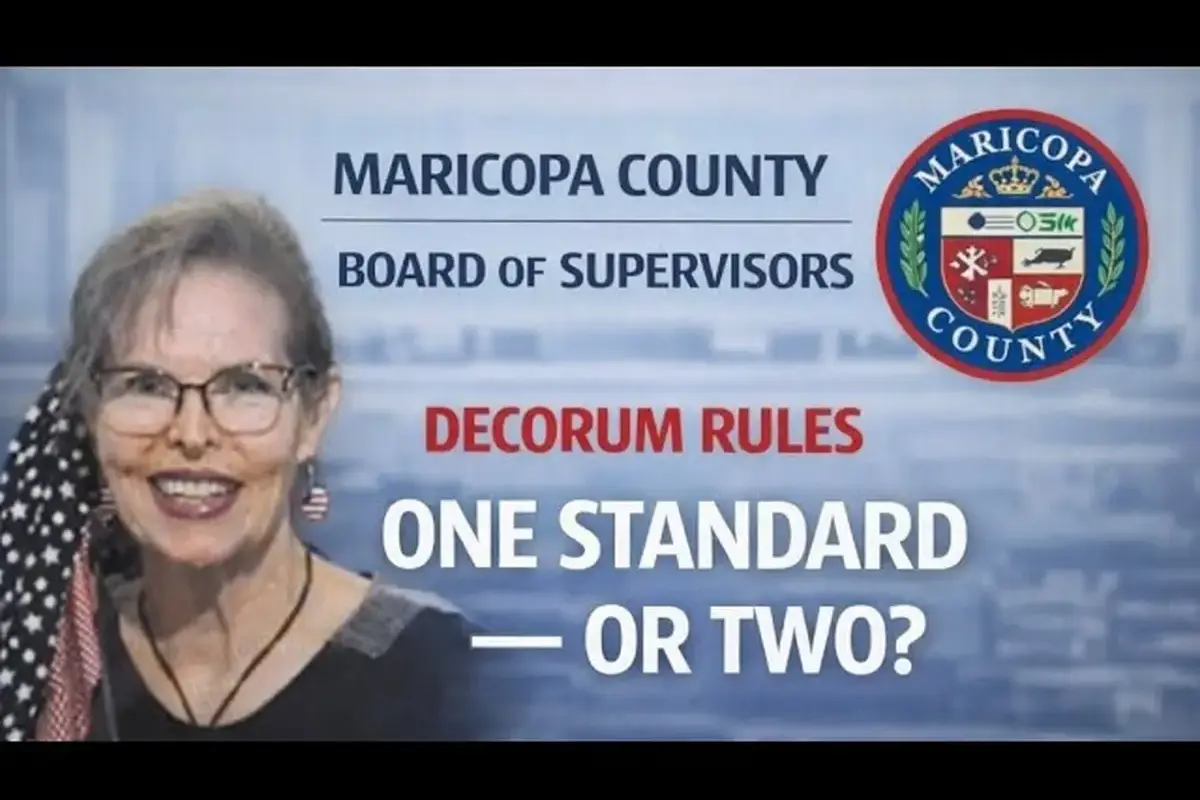
War with Recorder Heap and the Drop Box Crisis
Meeting Type: Formal
Date: Wednesday, May 20, 2026
Duration: ~2.5 hours (formal) + Executive Session
Chair: Kate Brophy McGee (District 3)
Vice Chair: Debbie Lesko (District 4)
Executive Summary: Open Warfare
The May 20, 2026 Formal meeting was not the quiet return to normalcy previously described. Beneath the routine zoning approvals and Framework 2040 passage, the meeting contained:
- A Split Vote with Personal Accusations — Steve Gallardo publicly accused Recorder Justin Heap of dishonesty, lies, and potentially wanting elections to fail. Gallardo voted NO on Recorder’s Office funding.
- An Emergency Executive Session — The Board recessed into executive session for legal advice regarding escalating conflict with Heap.
- The Drop Box Crisis — An emergency Addendum Item 97 addressed a threatening letter from Heap’s attorney threatening Class 5 felony charges against temporary election workers for operating drop boxes.
- Heap’s Refusal to Appear — Despite being invited by phone and email, and being physically in the same building, Heap refused to attend the meeting to address the Board’s concerns.
The Bottom Line: Maricopa County election administration is in crisis. The Board and Recorder are in active litigation, exchanging threats, and unable to coordinate on the 2026 election cycle. This is not routine governance — this is institutional breakdown.
Part I: The Morning Session — Routine Business
Opening Ceremonies
| Presenter | Organization | Role | Invited By |
|---|---|---|---|
| Rob Benile | Vitalent | Invocation | Supervisor Galvin |
| Bobby Shaw | Vitalent | Pledge of Allegiance | Supervisor Galvin |
| TJ Mitchell | Vitalent (former Gates chief of staff) | — | Supervisor Galvin |
Context: Vitalent is a blood services company headquartered in District 2 (Galvin). TJ Mitchell previously served as Chief of Staff to former Supervisor Bill Gates. The invocation emphasized “wisdom, sound judgment, and shared commitment.”
Part II: The Explosive Vote — Recorder’s Office Budget (Item 45)
Background
Item 45 was a budget adjustment for the Maricopa County Recorder’s Office: $232,446 for FY 2026 and $1,193,475 for FY 2027. The Recorder is an independently elected official (Justin Heap, elected 2024).
Gallardo’s Devastating Critique
Supervisor Steve Gallardo requested Item 45 be removed from the consent agenda and delivered a public excoriation of Recorder Justin Heap:
“I was working with Keith Purcell, Adrian Fontes, Steven Richards, and now Mr. Justin Heap. And I don’t think I’ve ever seen a more difficult time between the relationship between this board and the county recorder’s office.”
“It has been almost a year and a half since Mr. Heap has taken office. It has been an ongoing struggle to collaborate with this office to work together.”
“Since day one, he has put out false statements. He has not been truthful with this board.”
“Half the time, Madam Chair, I can’t even take his word on many of the stuff he says.”
“I have some strong doubt of his ability to carry out the 2026 election. I have some doubt that of him wanting to truly have a successful election. I think there’s a thought in my mind that perhaps maybe he wants it to fail.”
“I can’t even take his word for anything he says. He has a reputation so far with me at least of not being very truthful and honest. Has put out definite lies on me saying that I’ve said stuff that I’ve never said.”
“I just have to do it in the best interest of taxpayers and the people of Maricopa County and I will be opposing item 45.”
The Vote
| Supervisor | Vote | Explanation |
|---|---|---|
| Mark Stewart | Aye | — |
| Thomas Galvin | Aye | — |
| Debbie Lesko | Aye | — |
| Steve Gallardo | No | Stated: “I vote a resounding no” |
| Kate Brophy McGee | Aye | “As chair of this board and for no other reason, I vote Aye” |
Result: Passed 4-1
Critical Context: Brophy McGee’s explanation — “for no other reason, I vote Aye” — suggests she voted despite reservations, fulfilling procedural duty as chair rather than genuine support. Gallardo’s explicit “resounding no” with detailed accusations represents the first formal break in board unanimity on election matters.
Part III: Executive Session — The Legal Crisis
Immediately following the Recorder’s Office vote, the Board recessed into executive session.
“I am seeking a motion to recess this meeting and go into executive session for the purpose of obtaining legal advice.” — Chair Brophy McGee
Motion: Lesko/Galvin — Unanimous to enter executive session
Duration: Approximately 1 hour 40 minutes (from ~10:00 AM to ~11:40 AM)
Subject: Legal advice regarding conflict with Recorder Justin Heap
What This Tells Us: The Board needed confidential legal consultation mid-meeting. This is not routine. The written minutes (Item 97) show the Board retained outside counsel (Statecraft PLLC — Kory Langhofer) for election matters on May 18. Now, two days later, they needed additional legal advice during a formal meeting.
Part IV: The Emergency Addendum — Drop Box Crisis (Item 97)
The Crisis Unfolds
After returning from executive session, Chair Brophy McGee introduced Addendum Item 97 — an emergency resolution on drop boxes that had not been on the original agenda.
Why Emergency: The Board received a threatening letter from Heap’s attorney James Rogers that morning threatening criminal prosecution.
The Threatening Letter
Lesko read excerpts from the letter on the record:
“If the board establishes dropboxes during early voting without statutory authority to do so… any person or entity involved in establishing or operating such unauthorized dropboxes is committing a Class 5 felony.”
“Board employees who collect ballots at dropboxes established without the recorder’s legal authority are not acting within the scope of lawful official duties… Such employees therefore do not fall within the statutory exception and they are committing criminal ballot harvesting.”
Lesko’s interpretation:
“It sounds like the lawyer in this letter is threatening to criminally charge temporary election workers for merely doing their duty… These are people that could get paid $18 an hour.”
Timeline of Escalation (From Galvin’s Statement)
| Date | Action | Significance |
|---|---|---|
| May 6 | Heap wrote County Manager: Board cannot communicate with Recorder staff | Communication breakdown |
| May 18 | Heap’s attorney threatened sanctions/contempt for routine operations | Legal escalation |
| May 19 | Heap wrote County Manager: Board cannot get legal advice from County Attorney | Attempt to block counsel |
| May 20 | Attorney Rogers threatened felony charges against employees | Criminal escalation |
Galvin’s Condemnation
Thomas Galvin delivered equally strong criticism:
“Recorder Heap keeps changing his positions and we’re going back on agreements that’s making it impossible to coordinate because state law mandates that the board of supervisors coordinate with the recorder’s office.”
“This is the first time that I can recall of our own employees and volunteers being threatened with criminal penalties, not only in Maricopa County, but in Arizona, in the United States of America. This is shocking and appalling.”
Direct address to Heap (who wasn’t present):
“Recorder Heap, my question to you, sir… how do you expect us to run an election under these rules?”
“By trying to hamstring this board for political reasons and gamesmanship, by trying to block us from approving voting locations and then dropbox locations, the recorder is effectively taking away access to voters. His goal here is to punish the voters. You are making it harder, Mr. Heap, for registered voters to cast a ballot.”
Heap Refuses to Appear
Brophy McGee revealed:
“I did call Recorder Heap just to reiterate. I also sent him a simultaneous email around noon today asking him to appear here at 1:00. He’s right up a few floors up above in this building… but he is making the choice not to appear.”
Lesko’s invitation:
“I invited recorder Heap to appear at this meeting voluntarily. He was invited by an email from me and also by a direct phone call from me… but he didn’t show up as we have invited him.”
Significance: The independently elected Recorder, who is in active litigation with the Board, who threatened county employees with felonies that morning, refused to appear before the Board when invited to explain his position. This is not normal intergovernmental relations.
The Resolution Passes
Despite Heap’s threats, the Board passed the resolution authorizing drop boxes for the 2026 Primary Election.
Key Provisions:
- Authorized vote centers for 2026 Primary (Exhibit A)
- Authorized emergency voting centers (Exhibit B)
- Authorized secure drop boxes (Exhibit C)
- Director of Elections authorized to sign facility agreements
- Director authorized to designate alternate locations if originals unavailable
Vote: Lesko/Galvin — 5-0 Unanimous
Even Gallardo, who had just voted NO on Heap’s budget, voted YES on drop boxes. This suggests the Board is unified on maintaining election infrastructure despite the Recorder’s objections.
Part V: The Lesko Pattern — Motion Control Amid Chaos
Despite the crisis, Lesko maintained 100% motion control:
| Motion | Context | Seconder |
|---|---|---|
| P&Z Consent (3 cases) | Routine zoning | Stewart |
| Framework 2040 | Comprehensive plan | Galvin |
| Bingo License | Apache Junction | Gallardo |
| Road File 6032 | Zanjero Trails | Gallardo |
| Road File A0760 | Carefree Hwy | Gallardo |
| Road File A0759 | El Mirage Road | Gallardo |
| Item 45 (Recorder Budget) | Contested | Galvin |
| Executive Session | Legal crisis | Galvin |
| Item 97 (Drop Boxes) | Emergency | Galvin |
Pattern: Galvin seconded the contested/crisis items (Recorder budget, executive session, drop boxes), suggesting he has claimed the “election/legal” portfolio.
Part VI: The Written Minutes vs. The Video Transcript
What the HTML Minutes Show
The official written summary (OnBase Agenda Online) shows:
- Item 97: “ADOPT RESOLUTION FOR THE 2026 PRIMARY ELECTION”
- Dry legal text about vote centers and drop boxes
- Roll call vote: 5-0
- No context about threats, crisis, or confrontation
What the Video Transcript Reveals
The SRT transcript captures:
- Personal accusations of dishonesty
- Claims Heap wants elections to fail
- Criminal threats against $18/hour workers
- Refusal to appear despite being in the building
- Emergency executive session
- Direct challenges to Heap’s integrity
The Lesson: Written minutes are official records but incomplete records. They capture votes, not conflict. They record decisions, not deliberation. For accountability journalism, the video transcript is essential.
Part VII: Connections to Broader Patterns
The May 18 Context
This crisis didn’t emerge overnight. May 18 Executive Session (two days earlier) included:
- Statecraft PLLC retained — Outside election counsel (Kory Langhofer)
- Steve Tully present — Additional litigation counsel
- Election administration focus — Board authority and Recorder conflicts
The Board knew litigation was coming. They retained outside counsel. Two days later, they were in open warfare.
The Independently Elected Problem
Justin Heap is not accountable to the Board. He was elected by voters in 2024. The Board cannot fire him. They can only:
- Cut his budget (politically dangerous)
- Sue him (active litigation)
- Appeal to public opinion (what happened here)
This creates structural conflict: The Board must coordinate with Heap to run elections, but Heap has political/electoral incentives to challenge the Board. Both claim voter mandates. Both have legal authority. Neither can override the other.
The Criminal Threat Strategy
Heap’s attorney threatening felony charges against temporary workers is a nuclear escalation. Why?
- Chilling effect: Workers may quit rather than risk prosecution
- Operational disruption: Board can’t staff drop boxes if workers fear arrest
- Political messaging: “The Board is operating illegally” narrative
- Leverage: Forces Board to either back down or challenge in court
The Board’s response — passing the resolution anyway — signals they will not be deterred by threats. This sets up a court battle over statutory interpretation: Who has authority to authorize drop boxes?
Part VIII: Critical Analysis
Who Is Right? The Legal Question
Heap’s Position (per his attorney):
- ARS 16-411B4 grants Board authority for vote centers
- ARS 16-411B5 grants Board authority for emergency voting centers
- Drop boxes are not explicitly mentioned in these statutes
- Therefore, only the Recorder can establish drop boxes (under separate authority)
- Board establishing drop boxes = unauthorized = felony for workers
Board’s Position (implied):
- Drop boxes have been used for years without issue
- Statutory authority over “voting centers” implicitly includes collection points
- Heap’s interpretation is novel and politically motivated
- Recorder cannot unilaterally veto election infrastructure
The Real Question: This will be decided by courts, not by who has the better statutory interpretation. Both sides can make plausible legal arguments. The question is: Why now? Why threaten workers with felonies weeks before an election?
The Political Dimension
Heap was elected in 2024 on a platform of election integrity/skepticism of 2020-2022 procedures. The Board (3 Republicans, 2 Democrats) is accused by Heap’s supporters of being “establishment” Republicans protecting the status quo.
Heap’s base: Wants stricter election controls, fewer drop boxes, more scrutiny
Board’s position: Needs to run accessible elections, maintain infrastructure, avoid chaos
This is not a policy dispute that can be resolved by compromise. It’s a zero-sum ideological conflict over the nature of elections in Maricopa County.
Part IX: Red Flags — Updated and Expanded
🚩 Critical Red Flags
- Criminal Threats Against Workers
- Felony threats against $18/hour temporary employees
- Chilling effect on election staffing
- Follow-up: Are workers quitting? Has anyone been charged?
- Refusal to Appear
- Heap invited by phone and email
- In the same building
- Refused to explain himself
- Follow-up: Has Heap ever appeared before the Board? When was last time?
- Executive Session Mid-Meeting
- Not routine legal review
- Emergency session during formal meeting
- Follow-up: What legal advice was given? What are next steps?
- Split Vote with Personal Accusations
- Gallardo’s public accusations of dishonesty
- Brophy McGee’s “for no other reason” vote
- Follow-up: Is Gallardo’s assessment shared by others? Off-record?
- Timing of Threat Letter
- Sent morning of meeting
- Last-minute escalation
- Follow-up: Strategic timing to disrupt Board action?
🔍 Investigation Priorities (Updated)
- Obtain Heap’s attorney letter (James Rogers, dated May 20)
- Review Statecraft PLLC contract — scope and cost
- Interview temporary election workers — are they aware of threats?
- Track litigation — what cases are active between Board and Recorder?
- Check previous meetings — when did this conflict start? First shots?
- Review May 19 letter — “Board cannot get legal advice from County Attorney”
- Public records request — all communications between Board and Recorder since January 2025
Part X: Conclusion — Governance in Crisis
The May 20, 2026 meeting reveals Maricopa County election administration in active crisis. This is not “quiet governance.” This is open institutional warfare between:
- A Board of Supervisors trying to maintain election infrastructure
- An independently elected Recorder using legal threats to block that infrastructure
- Criminal threats against county employees
- Litigation as the primary mode of intergovernmental communication
The previous report describing May 20 as “quiet” and “efficient” was fundamentally wrong because it relied only on written minutes that captured votes but not conflict. The video transcript reveals crisis-level conflict that threatens the 2026 election cycle.
What This Means:
- Election workers are being threatened with felonies
- Drop box locations are legally contested
- Board and Recorder cannot coordinate
- Litigation is the default communication method
- The public is largely unaware (zero media coverage visible in transcript)
The Democratic Question: Can a county of 4.5 million people hold fair, accessible elections when the two bodies legally required to coordinate are in open warfare, exchanging criminal threats, and unable to appear in the same room?
The Answer (May 20, 2026): Unclear. The Board passed the drop box resolution despite threats. Heap has not backed down. Courts will decide. Workers are caught in the middle.
This is not governance. This is institutional collapse dressed in procedural clothing.